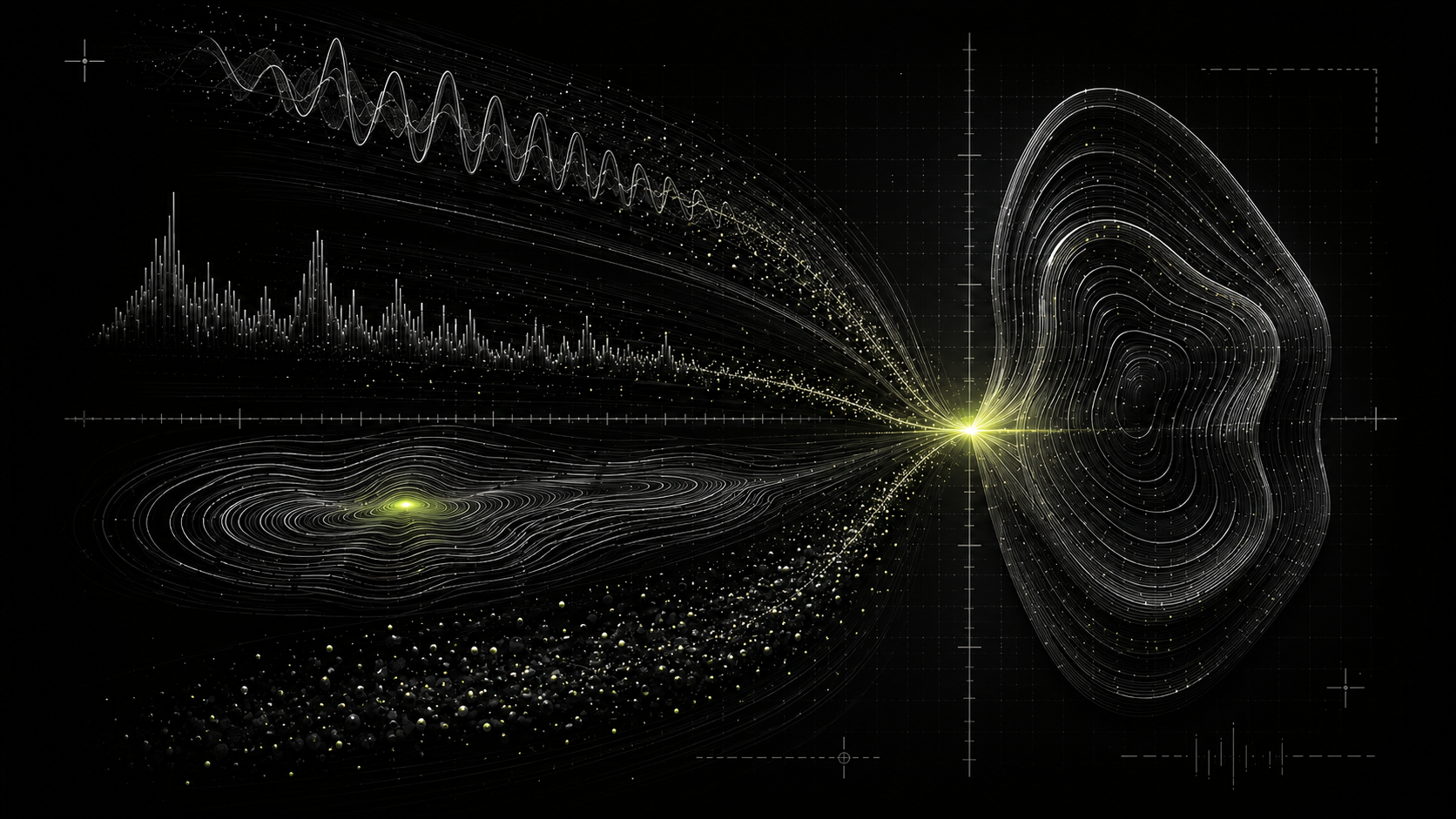
Interrogate
Create or identify physical interactions that contain information about the condition of interest.
Measurement beyond the obvious
NSense develops measurement systems that extract deterministic information from complex physical interactions—revealing emerging conditions that conventional sensors cannot detect.
Every physical interaction produces information. Materials deform. Structures vibrate. Surfaces reflect light. Electrical properties fluctuate. Biological systems continuously adapt and respond.
Conventional sensors isolate a specific signal and measure a predefined property. This approach is powerful—but it can discard subtle, distributed, or unexpected information contained in the behavior of the larger system.
NSense develops new ways to recover that information.
“We ask not only, ‘What can this sensor measure?’ but ‘What does this entire physical interaction reveal?’”
NSense approaches sensing as a problem of inference. We identify how an underlying condition influences observable physical behavior, deliberately interrogate the system, and combine the resulting signals into an estimate of its state.
Create or identify physical interactions that contain information about the condition of interest.
Capture multiple optical, mechanical, electrical, acoustic, thermal, chemical, or biological responses.
Use physical models, system identification, signal processing, and machine intelligence to discover meaningful relationships.
Convert complex patterns into actionable information about properties or conditions that may not be directly measurable.
The sensor is not necessarily a single device. It may be the entire interacting system.
Explore the full methodology →The NSense methodology is intended for problems in which relevant information is subtle, distributed across many signals, or inaccessible to conventional sensing architectures.
Failure prediction
Integrate subtle changes in physical behavior to identify emerging failure conditions, including precursors that may not correspond to previously documented failure modes.
Predict what conventional monitoring does not yet know to look for.Counterfeit detection
Combine physical interrogation, sensing, and computational analysis to determine whether an object behaves consistently with an authentic reference.
Go beyond appearance to measure what an object physically is.Emerging health states
Explore measurement systems that integrate minute signals, establish personalized baselines, and identify emerging deviations that may warrant investigation.
Detect changes that no single biomarker reveals on its own.A difficult sensing problem may require reconsidering which physical interactions contain the needed information and how that information can be extracted.
What do you need to know that cannot be measured adequately today?
How does the condition influence the system, environment, object, or organism?
Which modes of interrogation, observation, modeling, and inference can reveal it?
Establish the experiments, instrumentation, data, and validation needed to test the concept.
A question worth measuring
Tell us about the condition you need to detect, the system you need to understand, or the change you need to recognize earlier.